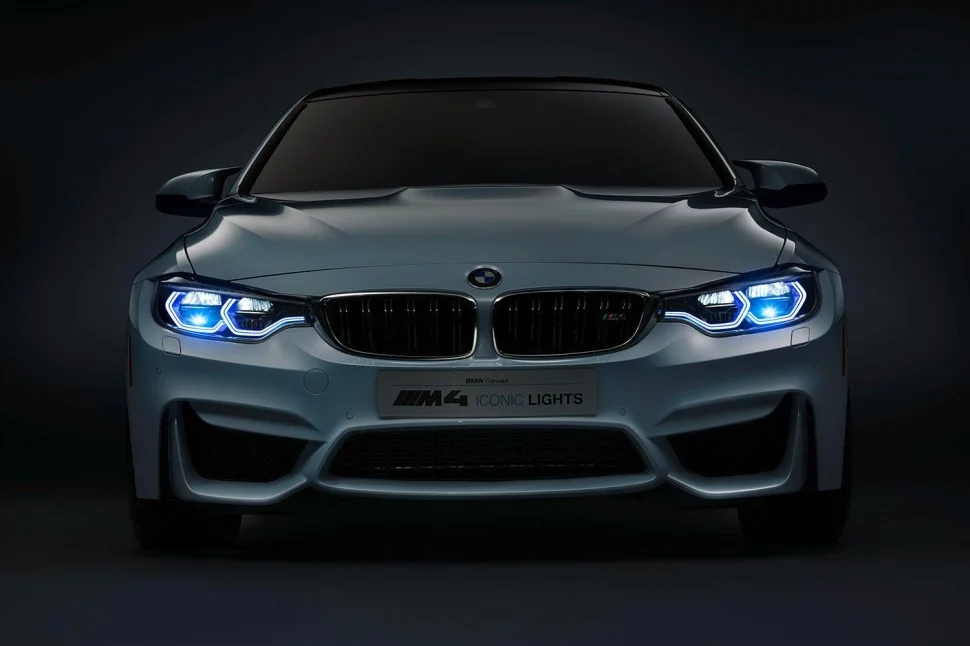
BMW Dazzles CES with the BMW M4 Concept Iconic Lights

By Alexander Kalogianni - Digital Trends

Like everything else on cars nowadays, headlamps are getting smarter. We’ve already begun moving away from heavy, space-hogging bulbs in favor of smaller OLEDs, giving us cleaner beams of light in the process. Having brought laser boosted lighting to the market with the i8 hybrid sports car, BMW illuminates the path ahead with BMW M4 Concept Iconic Lights vehicle.

The white metallic car itself is just a showcase of how the future lights would look on a typical BMW vehicle. The laser lights themselves starts blue in color, but a phosphor plate inside the light converts it to a bright white light that mimics daylight. The beams are ten times as powerful as any other light source like xenon or LED, and has a projection range of 600 meters.

You’re probably reading this now, imagining how blind you’ll be when one of these heads down the road ahead of you. Don’t worry, BMW’s thought of that, too. Dynamic actuators control the Selective Beam system, which spots oncoming traffic with a set of cameras and prevents the headlights from dazzling oncoming vehicles.

In fact, the dynamic ability of these lamps goes even further, allowing people and animals detected by an infrared camera to be “spotlighted” for the driver’s immediate attention. Forward sensors can also detect if the way ahead has enough clearance for the vehicle and provides a laser projection to indicate the available width.

From a design standpoint, the implementation of laser and OLED headlights open up realm of possibilities to give the vehicle a distinct appearance, front or back. For instance, as each segment can be individually illuminated, the lights could change so something more fierce in appearance if sport mode was selected.

The headlights themselves may be designed to prevent dazzling other drivers, but consider us stunned.

BMW retakes U.S. luxury auto sales crown from Mercedes-Benz

BY Bernie Woodall

(Reuters) - BMW (BMWG.DE) on Monday regained bragging rights as the top-selling luxury brand in the United States, ending the one-year reign of German rival Mercedes.

BMW ended with a lead last year of more than 9,000 vehicles over Mercedes-Benz, which in 2013 seized a title BMW had held for the previous two years.

The BMW brand sold 339,738 vehicles in the U.S. market last year, a 9.8 percent jump from 2013. BMW's sales growth outpaced the overall U.S. auto market's 5.9 percent increase. Daimler AG's (DAIGn.DE) Mercedes-Benz brand showed an increase of 5.7 percent to 330,391 vehicles.

Last year, Mercedes-Benz outsold BMW by about 3,000 vehicles. BMW won the sales crown in 2011 and 2012.

Toyota Motor Corp's (7203.T) Lexus brand narrowed the gap on the two German brands, but remained in third last year with 311,389 vehicles, up 13.7 percent.

From 2000 to 2010, Lexus was the luxury sales leader, but the two German brands jumped the Japanese brand in 2011 when a damaging earthquake and tsunami struck Japan.

Volkswagen AG's (VOWG_p.DE) Audi brand overtook General Motors Co's (GM.N) Cadillac for fourth place. Audi's sales of 182,011 were up 15.2 percent while Cadillac sales fell 6.5 percent to 170,750 vehicles.

Honda Motor Co's (7267.T) Acura brand showed a 1.5 percent gain in the year to 167,843 vehicles, followed by Nissan Motor Co's (7201.T) Infiniti at 117,300 vehicles, up 0.8 percent.

In eighth place but gaining was Lincoln, the Ford Motor Co (F.N) luxury brand that a couple of decades ago was the luxury market leader. Lincoln's sales rose 15.6 percent in the year to 94,474 vehicles.

Owners of BMW electric cars get paid not to drive

By David R. Baker - San Francisco Chronicle

Some Bay Area drivers of the BMW i3 electric hatchback may soon qualify for an odd perk — getting paid to delay recharging their cars.

Drivers who participate in the German automaker’s new i ChargeForward program will receive up to $1,540 in return for letting BMW delay the recharging process whenever California’s electricity grid faces a heavy strain. The delays are expected to last no longer than an hour.

The experimental program — developed by BMW and Pacific Gas and Electric Co. — will test one way to ensure that electric vehicles don’t burden the grid as their popularity slowly grows. If it works well, it could lead to a future in which EV drivers get paid for helping to maintain the grid’s stability. And that money could, in turn, offset the price of electric cars, which still cost substantially more than their gasoline-burning brethren.

“If they will provide us grid service, we can provide them some incentives that will help lower the cost of these vehicles,” said James Ellis, PG&E’s director of electric vehicle programs.

The new program, announced by PG&E and BMW Monday, is just one of many efforts under way to study how best to plug electric cars into the grid. A consortium of automakers, including BMW, is developing a standardized communication platform that will let utilities communicate with their customers’ EVs, letting utilities balance charging times among thousands of customers. Some researchers are also studying ways to use electric cars as big batteries that could feed power to the grid when necessary.

That won’t be part of the BMW experiment.

Instead, BMW and PG&E want to see if they can persuade drivers to give up a little control over recharging times, to prevent electric cars from straining the grid when power supplies are low. It’s similar to the “demand response” programs that utilities already run, which typically give big businesses a break on electricity bills in return for agreeing to cut power use during emergencies.

Starting this month, BMW will seek online applications from Bay Area i3 drivers willing to participate in the program. Those interested can register at www.bmwichargeforward.com. The program will enroll 100 drivers, who will receive $1,000 up-front.

Whenever power supplies on the electricity grid run low — say during summer afternoons — PG&E will send a notice to those drivers through a BMW smartphone app. The notice will warn them that their plugged-in cars will temporarily stop charging. Drivers who absolutely need a full charge can use the smartphone app to opt out, ensuring that charging continues.

At the end of the program, in late 2016, drivers will receive a second payment worth up to $540, based on the number of times they let the system delay charging.

In all likelihood, not all participating drivers will agree to delay charging each time the system sends an alert — they could be on the road or know they need a full charge soon. So BMW will tap a bank of used electric-car batteries, located at the automaker’s technology office in Mountain View, to make up the difference, sending PG&E enough electricity to make up for the drivers who opted out.

“That’s our way we’re ensuring that we always meet our commitment to PG&E while never sacrificing mobility for our customers,” said Julia Sohnen, an advanced technology engineer in sustainable mobility for BMW.